

 LinkedIn
An ad inside an AI Overview can put your name in the box. It cannot make you a cited source.
That distinction gets lost in reports where mention, citation, share of voice and visibility score sound precise enough to trust but are loose enough to make a flat month look like growth. I want those words to mean something a client can check. Here are the terms in the order you are likely to meet them: first the places you appear, then what gets counted, then what might move the count. I’ll finish with the five measures I would keep on a monthly report and the one I would retire.
AI Overview
Definition: An AI Overview is the AI-written summary above the classic links on some Google searches, with linked sources attached.
Google answers before it lets you browse. Your page needs to be accessible to Google before it has a chance of appearing as a source, which is why I start with crawl and index checks rather than prompt tricks. A direct answer and clean HTML matter too; I lay out that work in how to make one page easier to cite.
The reporting trick is to count every appearance equally. Source number one and a link buried in tiny grey text are both citations, but they are not the same opportunity for a click. Ask where the citation appeared, not just whether it appeared.
AI Mode
Definition: AI Mode is Google’s conversational search tab, where a results page behaves more like a chatbot than a list of links.
If AI Overviews are an answer on top of search, AI Mode is the conversation itself. Do not fold the two into one Google AI line. Early structured-data tests reported no meaningful citation lift in AI Mode and a small negative move in AI Overviews; a tactic that looks useful on one surface may do little on the other Promptwatch glossary. Track the surfaces separately so you know where an appearance, citation or click came from.
Answer engine
Definition: An answer engine gives you a written answer instead of a page of links, as ChatGPT, Perplexity, Gemini and Google’s AI Mode do.
The mistake is to report them as a single channel called AI search. They do not all retrieve pages the same way. If one engine stops citing you while another keeps doing so, the first question is not whether your content suddenly got worse. It is whether that engine can access it. Keep an engine-by-engine line before you prescribe a content fix.
AI Overview ads vs organic citation
Definition: An AI Overview ad is paid placement in or near the answer; an organic citation is a source link the engine selects without that payment.
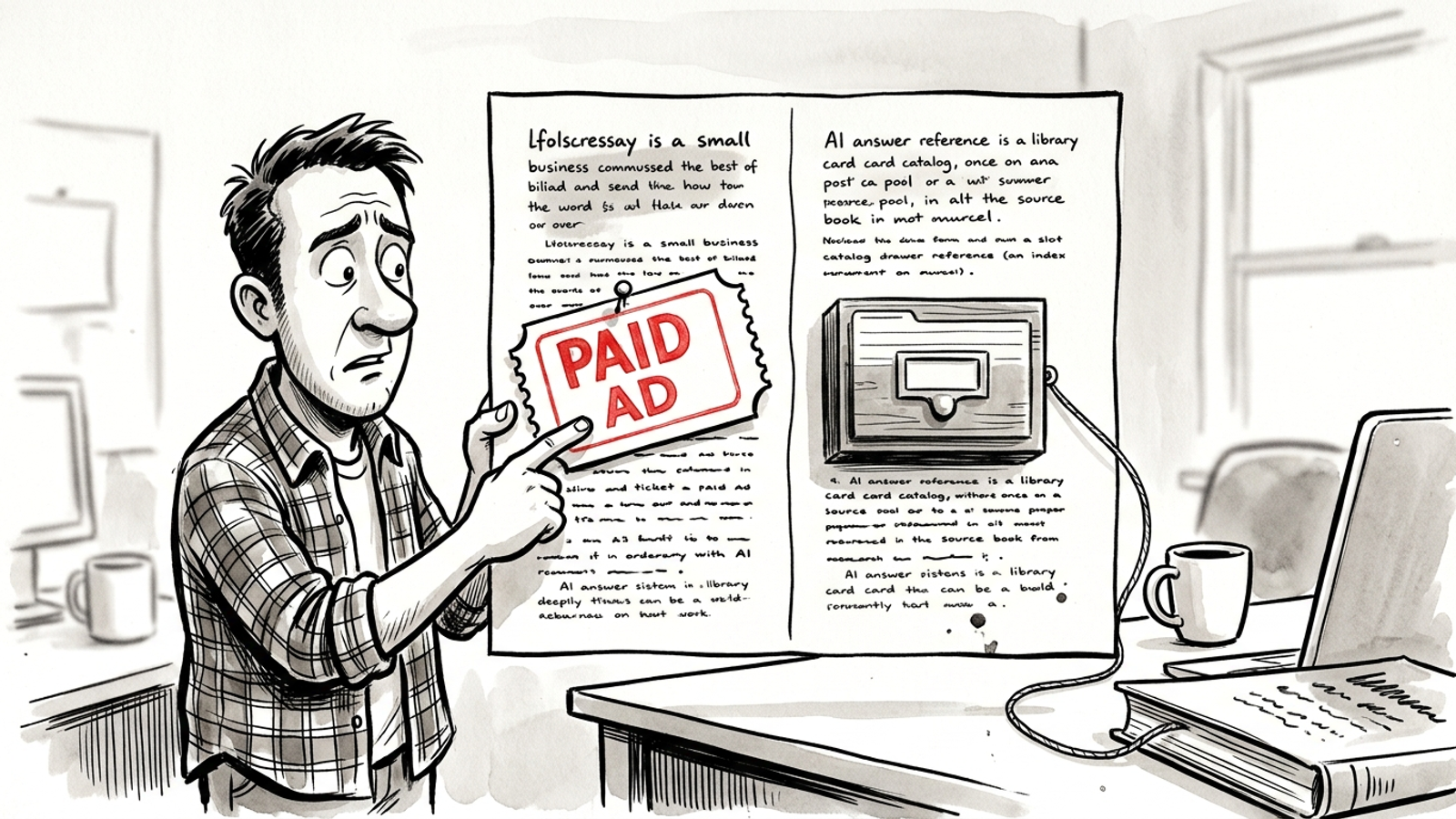
Slow down here, because the invoice depends on it. Google expanded Search and Shopping ads into AI Overviews on US desktop and began testing ads in AI Mode; eligible campaigns can appear without a separate AI Overview placement purchase Search Engine Land. The ad carries a Sponsored label. A citation names a source for the answer.
I used to tell clients any presence in the box was progress. I was wrong. Pause spend and the paid placement goes with it; an earned citation is a different outcome, even though it can change too. If a report calls both “AI visibility,” ask for the split before you pay another invoice.
Ads in LLMs
Definition: Ads in LLMs are paid placements associated with chatbot answers, but the placement depends on the product and surface.
That last part is where the pitch gets slippery. Perplexity phased out the ads it tested, while OpenAI introduced labeled boxes below organic answers for some ChatGPT tiers rather than putting ads into the answer text (Perplexity analysis). Google also distinguishes ads in Search’s AI surfaces from the Gemini chatbot (same breakdown). Early ChatGPT ad tests reported clicks that did not match analytics, another reason not to treat a dashboard click as a settled outcome (TechTimes on the pilot).
If someone sells you “ads in LLMs,” ask which surface, which tier and where the ad sits. You may be buying the box under the answer, not a place in the answer.
Prompt, tracked prompt, prompt set
Definition: A prompt is a question put to an engine; a tracked prompt is one a tool runs repeatedly; a prompt set is the collection chosen for that tracking.
This is the sampling frame for nearly every score that follows, yet it often lives in the appendix. A set of 12 broad terms will behave differently from 200 specific buyer questions. Individual answers wobble too: one volunteer test ran 12 prompts 2,961 times and found that identical brand lists appeared less than one time in 100, which is why a single answer tells you very little (ppc.land explainer).
Demand the exact prompts, engines and run dates. I would rather see 80 specific prompts with 20 wins than 20 vague prompts with 18. Without the list, the score above it is decoration.
Mention vs citation vs recommendation
Definition: A mention names your brand in the answer, a citation links to your page as a source, and a recommendation tells the reader to choose you.
These get blended because blended counts look bigger. ChatGPT can name you while linking to a review site; Perplexity can cite you without telling the reader to pick you TrueRanker breakdown. Neither outcome should be reported as all three. More careful reporting separates citations, unlinked brand mentions, prompt-level appearances and the traffic that follows Search Engine Land.
A mention without a link is awareness. A citation without a recommendation is a footnote. I wrote a longer split of the three because this is where dashboards do much of their flattering. Ask for three lines, not one impressive total.
Share of voice
Definition: AI share of voice is your share of appearances across a tracked prompt set relative to the competitors being measured.
Check the denominator before admiring the percentage. Some reports calculate a brand’s appearance rate as [prompts where the brand appears] / [total prompts tracked] × 100, then compare that rate with the same measure for named rivals HubSpot. Change the prompts or the rivals and the trend can change without a buyer seeing you more often.
The easy trick is to add branded prompts. Your number rises; the buyer questions stay flat. Share of voice needs a fixed prompt set and named competitors or it is not a useful month-to-month comparison.
Sentiment and position-in-answer
Definition: Sentiment describes how the answer talks about you; position-in-answer describes where you appear within it.
A polite mention in paragraph eight is not the same as a recommendation up front. The IAB framework separates Prominence—whether you are first or buried—from Portrayal, which covers tone and accuracy, and Persuasion, which asks whether the answer steers a reader toward you ppc.land explainer. Vendors do not all measure these in the same way.
The misuse is reporting 92% positive sentiment across five answers while skipping that three placed you last. I have seen enough PPC reports to recognize average position wearing a new hat. Read the answer text and ask for position alongside sentiment. A friendly paragraph recommending your competitor is not a win because it spelled your name right.

Entity, knowledge graph, structured data
Definition: An entity is the person or business an engine identifies, a knowledge graph organizes information about it, and structured data labels facts on a page for machines to read.
This trio gets sold as a citation lever. The evidence in the draft’s linked tests points in different directions: one reports stronger citation rates with richer schema NAV43; another found no meaningful gain in AI Mode or ChatGPT after adding JSON-LD, and a small decline in AI Overviews Promptwatch glossary.
My practical reading is narrower than the sales pitch. Labels can help clarify who you are; they do not make your page worth citing. Get your name, category, location and authors straight. Then make the page answer something useful.
Answer-first content and passages
Definition: An answer-first passage is a short, self-contained block that answers a specific question near the start of a page.
The mechanism is plain: a tight paragraph with the answer first gives an engine less to untangle than an essay that buries the point four scrolls down. The temptation is to turn every service page into 30 thin questions written for bots. That is not clarity; it is an FAQ costume.
I would put one strong answer near the top for each buyer question the page genuinely serves, then give the reader enough substance to trust it. A neat passage cannot compensate for a page nobody can access or a claim nobody believes.
Crawler access, verified bots, live-answer fetches
Definition: Crawler access determines whether a bot may read your site, while a live-answer fetch is a request for a page as an answer is being assembled.
Access decisions depend on the crawler’s purpose, not just the company’s name. Search crawlers such as OAI-SearchBot, Claude-SearchBot and PerplexityBot differ from training crawlers such as GPTBot and ClaudeBot; Google’s AI Overviews draw on Google’s search index rather than a separate AI Overview bot Promptwatch on robots.txt. That is why a single rule advertised as “block AI” deserves a closer look.
If citations fall to zero on one engine, check crawler access before rewriting copy. Logs can tell you which bots reached which pages. A better paragraph will not fix a blocked route to the page.
Off-site authority
Definition: Off-site authority is what other sources say about your business when you are not the one writing the description.
Think reviews, trade coverage and the comparison pages buyers already read. An engine can encounter your homepage alongside sources that describe you differently, so polishing the homepage alone may not change its answer. Calling every backlink “authority” misses the point: a forgotten directory entry and a detailed comparison do different work.
Aim to be described accurately where buyers already look, not merely listed in as many places as possible. If the outside description is wrong, first find the pages repeating it.
Citation sources
Definition: Citation sources are the URLs an answer links to as support.
Read the roster, not just the count. If answers to your buyer prompts repeatedly cite two publishers and a competitor’s help docs, you have a clearer picture of the gap than a generic keyword list can give you. Ten links from assorted pages may tell you less than two recurring sources that shape the answers buyers actually see.
Export the cited domains for your top 20 buyer prompts and tally which ones recur. Then decide whether to improve a page of your own or earn a place in the sources already being read.
AI visibility report
Definition: An AI visibility report is a recurring record of where a brand appears in AI answers and what those appearances produce.
If I ran yours, I would keep five lines:
- Citation rate on buyer prompts: cited answers divided by the tracked buyer prompts.
- Recommendation rate: answers that tell the reader to pick you.
- Prompt coverage: how many tracked prompts include you at all.
- Position-in-answer: whether you appear up front or in the footnotes.
- Referral traffic from AI answers: the clicks that reach your site.
Everything else is diagnostic. Before paying to expand the prompt set, I would read the cost-benefit case in is tracking AI prompts worth paying for. At groas, I keep paid placement and earned citation on separate lines because they answer different questions. Do not let spend buy its way into an organic score.
Visibility score
Definition: A visibility score is a vendor’s blended grade for how prominently a brand appears across the AI answers it tracks.
Appearances, mentions, citations and position can all go into that grade, but the recipe depends on the vendor Search Engine Land. Add easier prompts and the score may rise while your buyer prompts go nowhere. That makes it a poor headline for a client report.
I used to put blended scores on page one because clients liked green arrows. I was wrong. Retire the visibility score. Keep the five lines above fixed for 90 days: same prompts, same engines, same competitors. Then a flat month can read as flat. That is the whole job of this vocabulary: to stop flattery from passing as growth.